A beginner’s guide to starting your practice (and maybe a short refresher for the rest of us).
Have you ever felt like the word witch already belonged to you before you ever did anything about it? Maybe it was a pull toward the moon you couldn’t explain. A drawer of collected stones and feathers. A feeling, reading about the craft late at night, of coming home rather than discovering something new. If that’s you, welcome. This post is the one I wish someone had handed me at the very beginning: how to actually become a witch, what to do first… and what to skip.
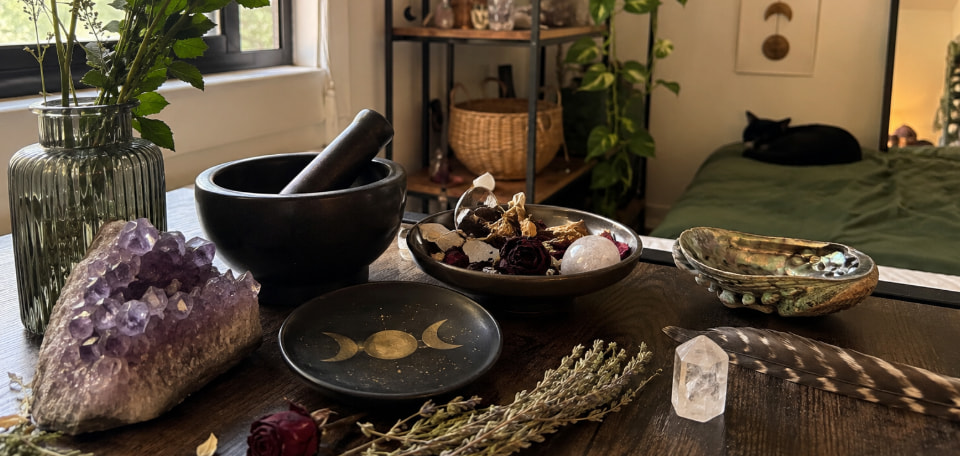
So… How Do You Actually Become a Witch? 
The answer is simple. You decide to be one, and then you practice. That’s really it.
There’s no licensing board, no bloodline requirement, and no ceremony you “have” to pass before you can use the word (though there are some I could certainly recommend). Magic is an innate human capacity, and anyone can develop it with time and consistent practice. You don’t need to come from a family of witches or belong to a coven, and you certainly don’t need anyone’s permission.
You become a witch by witching.
You can’t call yourself a painter if you never pick up a brush, and you can’t call yourself a witch if you never practice. Reading is wonderful (There is loads of great information here and decades of witchy books behind us), but a shelf of witchy books doesn’t make a witch. A single candle lit with full intention does. You’ll hear a few different ways of looking at it in the community. They can all be true at once:
-
It’s a decision. You become a witch the moment you say you are and start doing the work.
-
Building a practice works like strengthening a muscle or learning a language. Small and consistent steps beat grand but rare ones.
-
For many of us, it feels like something we awaken to. We felt the pull long before we had words for it, and the naming comes later.
-
Some traditions include an initiation. Lineaged covens initiate their members, which is beautiful, but that’s their doorway, not the only one.
And one thing to settle right away: you do not need to be Wiccan to be a witch, since Wicca is a religion while witchcraft is a practice. All Wiccans practice witchcraft; plenty of witches aren’t Wiccan at all. Your craft can be religious, spiritual, or entirely secular. All of it is valid. There’s a thread about the types of witches here, and even then it is just our opinions, not hard-set rules.
Your First Steps (Spend Nothing Yet) 
Put the wallet down. I mean it. The single most common beginner mistake is buying a cauldron, forty crystals, and a velvet cloak before learning a single skill. The strongest foundations are free.
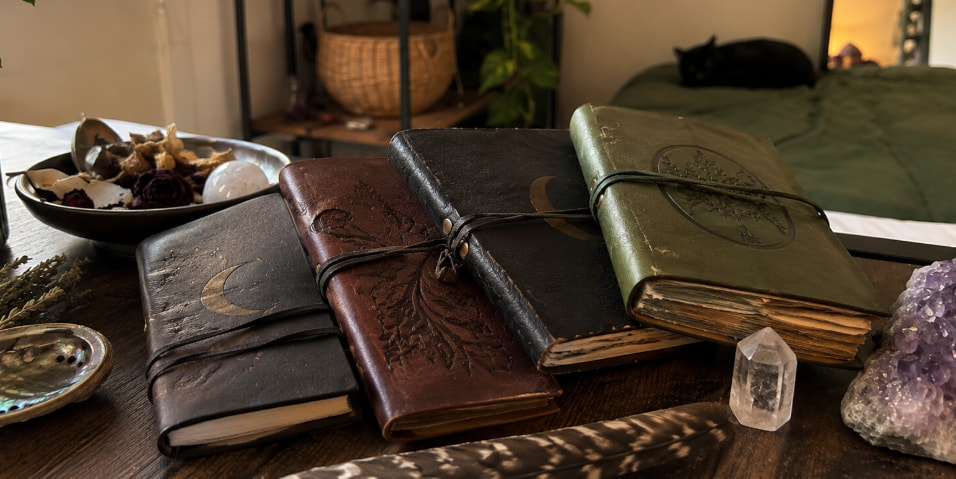
Start a journal. Call it a Book of Shadows, a grimoire, or just “my witch notebook.” A three-ring binder or the notes app on your phone works perfectly. Record what you learn, what you try, what happens. Years from now, this becomes your most precious magical possession. It’s the only thing you really need to get started.
Watch the moon for one full cycle. For about 29 days, jot down the moon phase, the weather, your moods, your dreams, anything odd or lovely you notice. This trains observation, the core witch skill no shop can sell you.
Learn grounding and centering. If you learn only one thing from this post, make it this. Sit comfortably. Breathe slowly. Visualize roots growing from your body deep into the earth. Exhale and release any frantic, excess energy down those roots. Inhale and draw steady, calm energy back up. Five minutes a day. Do it before and after any spellwork, like stretching before and after a workout. If you ever feel drained after magic, this is what was missing.
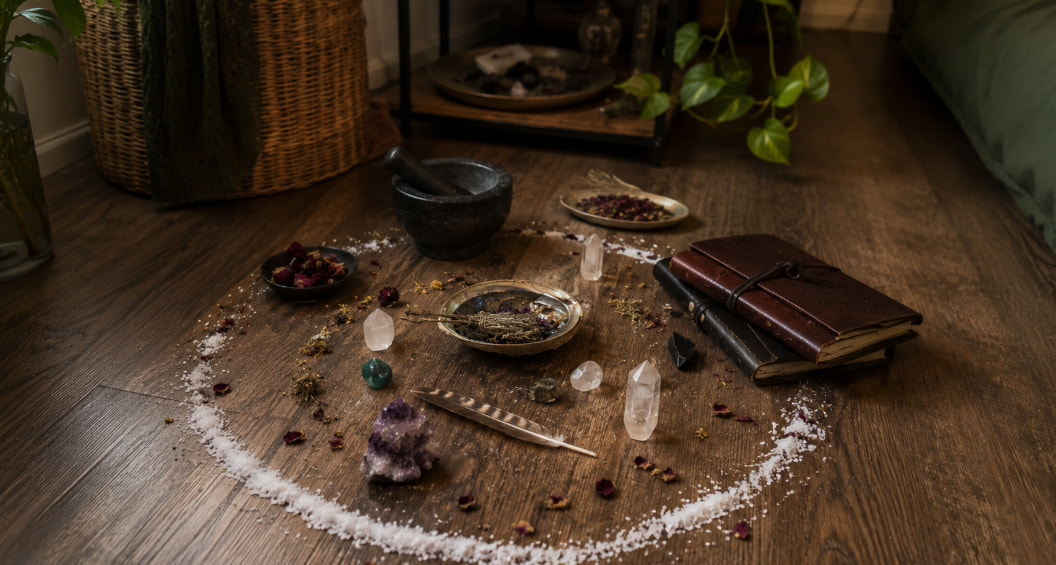
Build a tiny altar from what you already own. An altar is just a dedicated surface, a windowsill, a shelf, or a corner of your desk. You’ll see content creators with big expensive setups but you  do not need to be starting there. Represent the elements simply: a stone or dish of salt for Earth, a feather or incense for Air, a candle for Fire (a battery LED counts!), a small bowl of water for Water. I’ve worked beautiful magic with a coffee mug for a chalice and a butter knife for an athame. Intention is the tool. Everything else is decoration.
Read widely and critically. Scott Cunningham’s Wicca: A Guide for the Solitary Practitioner remains the gentlest classic starting point. Arin Murphy-Hiscock’s The Green Witch is lovely for the nature-drawn. Read more than one author, because reading widely is how you build your inner nonsense detector. There’s a wealth of information already here on the forum.
Foundational Skills 
These are the bones of nearly every spell you’ll ever cast:
-
Intention. The engine of all magic. Phrase intentions in the present tense, as if already true. “I am protected,” not “I want to be protected.”
-
Visualization. Seeing energy in your mind’s eye, as light, as roots, as a glowing ball between your palms. It feels like imagination at first. Keep going.
-
Raising and directing energy. Gathering energy through breath, movement, chant, or focus and sending it toward your intention.
-
Shielding. Visualizing a protective bubble of light around yourself. It is simple and worth doing every day.
-
Cleansing. Clearing stagnant or unwanted energy from yourself, your tools, your space. Smoke, salt, sound, or pure visualization all work.
-
Circle casting. Creating a temporary energetic boundary for your work. Beginners can simply walk the perimeter of their space, visualizing a ring of light, then open it when finished.
A word on cleansing herbs. Please don’t use white sage. Smudging with white sage is a closed Native American practice, and the plant itself is being overharvested to the point of crisis. Rosemary, garden sage, lavender, cedar, juniper, and mugwort are all open, abundant, and wonderful. Call it smoke cleansing, work with respect, and your practice loses nothing.
Correspondences: Guides, Not Rules 
Correspondences are symbolic associations that help focus your intent. Learn a few, hold them loosely. If a correspondence ever clashes with your intuition, trust your intuition. These are maps drawn by other spiritual travelers, not laws of physics. You’ll often come across a ritual someone writes using something in a way that might not suit you, just adapt it to suit you (that’s exactly why we write our own spells).
Candle colors: White substitutes for everything (keep a stash of white candles and you’re set). Red for passion and courage, pink for love and self-worth, green for money and growth, black for protection and banishing, blue for calm and healing, purple for psychic work.
Moon phases: New moon for fresh starts and setting intentions. Waxing to grow and attract. Full moon for peak power, charging, and divination. Waning to release and banish. The shorthand: waxing to draw in, waning to push out.
Days: Sunday for success, Monday for intuition and dreams, Tuesday for courage and protection, Wednesday for communication, Thursday for prosperity, Friday for love, Saturday for banishing and endings.
Five herbs to start with: Rosemary (protection and cleansing, the workhorse), basil (money and luck), bay leaf (write a wish on it and burn it safely), lavender (peace and sleep), and good old salt (protection, cleansing, everything).
Finding Your Path (Eventually) 
You’ll hear about green witches, kitchen witches, sea witches, hedge witches, cosmic witches, secular witches, and a dozen more. Don’t stress about choosing. Most of us are eclectic, weaving together whatever resonates, and your path will shift over the years. The labels are descriptions you grow into, not boxes you must climb inside on day one. Follow what pulls you. The name comes later, if it comes at all.
The same goes for solitary versus coven practice. Most modern witches practice alone, and solitary craft is complete in itself. If a coven ever calls to you, treat joining like a marriage. Never join just to belong and you are, of course, always welcome to join our coven here.
Ethics, Safety, and Staying Smart 
On ethics: you’ll quickly meet the Wiccan Rede (“an it harm none, do what ye will”) and the Threefold Law (what you send out returns three times). Know that these are Wiccan ethics, modern ones that are still debated even within Wicca. Many witches follow them; many don’t. Part of becoming a witch is sitting down and deciding what your ethics are. Take that seriously.
On physical safety, the unglamorous magic: never leave a burning candle unattended. Don’t over-dress candles with oils and herbs. You’re building a tiny bonfire. Research every herb before you burn or ingest it, dilute essential oils, and know that some crystals are toxic in water. The most dangerous thing in witchcraft is not a spirit but an unattended flame.
On the broom closet: if your household, family, or country makes open practice unsafe, discretion is wisdom, not cowardice. A tea ritual looks like tea. A windowsill altar looks like decoration. A digital grimoire is invisible. Your practice is no less real for being private. Protect yourself first.
On teachers and sources: run from anyone who tells you you’re cursed and only they can fix it (for a fee), who guarantees results, who hoards “secret knowledge,” or who discourages questions. Good teachers want you independent. And respect closed practices. Hoodoo, Brujería, Vodou and others belong to specific cultures and communities. The open traditions offer more than a lifetime of depth.
Building a Real Practice, One Small Day at a Time 
Forget the elaborate full-moon productions for now. Pick one or two of these and do them consistently:
-
Light a candle each morning and speak one intention for the day
-
Brew tea with intention stirred in, and drink it slowly
-
Make moon water under the full moon (label and date it!)
-
Take a weekly nature walk with your journal
-
Keep a short gratitude list before bed
-
Cleanse your space at the new moon
When you’re ready for a first spell, keep it simple: a white intention candle, or a little protection sachet with rosemary and salt along with a dark stone. The advice is always to write your own spell or ritual, but a good place to start is to take some simple rituals that speak to you (we have more than enough here) and modify them to suit you. Change whatever speaks to you and connects with your practice. If you don’t have something that the spell calls for, then replace it with whatever you do have that performs that task.
The Year and a Day (and the Imposter Feeling) 
Many traditions speak of studying for “a year and a day” before dedication, long enough to watch the full wheel of the seasons turn once. I love this as a frame, not as a rule but as permission. You are allowed to take a whole year just to learn and observe. There is no race. And let me say this clearly, because every single beginner needs to hear it: you will feel like a fake witch. Everyone does. The witch with the perfect Instagram altar feels it too. Imposter syndrome thrives in the craft because progress is invisible and there’s no graduation day. The cure is practice, recorded faithfully in that journal, until one day you flip back and realize how far you’ve come.
Whenever it calls to you, a month in or a year in, you can mark your commitment with a self-dedication ritual. Take a salt bath, light a candle, and speak your intention to walk this path aloud, in your own words, to the divine as you understand it (or simply to yourself). It won’t grant you powers, but it makes the decision real in a quieter and better way.
You were never waiting for permission. You were waiting for a beginning. This is it.
Blessed be 