Of all the ingredients on my altar, honey is the one I trust most to change a situation for the better. It can be so powerful that it spawned its own types of ritual. It’s patient where fire is fast and persuasive where words fail. It also sticks around long after a candle has burned out.
Most of us reach for honey only to “sweeten” a crush, because these rituals trended on socials, but this golden stuff is far stranger and more versatile than this reputation.
I’ve also covered the properties of bee pollen here if you’d like to work with the raw element.
Honey barely ages. Sealed jars were placed in ancient tombs as food for the afterlife, and that near-incorruptibility tells you everything about how our ancestors saw it: a bridge between the living and the divine, between the moment and forever.
Honey carries that slow ripening power into your practice.
Honey’s Metaphysical Properties
Spiritually, honey carries a cluster of energies that rarely get listed together. It is at once solar (golden, warm & vital) and receptive (slow, flowing & yielding), which makes it one of the most balanced ingredients witches work with.
- Persuasion & eloquence: honeyed speech and softened words that win favor
- Binding & sticking power: holding people, ideas, and outcomes together
- Sweetening: turning sourness, anger, and indifference toward warmth
- Preservation: keeping something whole and protected so it stays unchanged
- Sensuality & glamour: magnetism and allure with a boost of self-love
- Offerings & devotion: a near-universal gift to deities, ancestors, and land spirits
- Hive magic: cooperation and community with collective effort
- Slow magic: long-game workings that ripen over weeks, not minutes
Magical Correspondences of Honey
| Correspondence | Association |
|---|---|
| Latin Name | Mel |
| Planet | Sun, Venus |
| Element | Fire, Water |
| Signs | Taurus, Leo, Libra, Cancer |
| Deities | Aphrodite, Oshun, Ra, Melissa, Brigid, Demeter |
| Chakras | Sacral, Solar Plexus |
| Day | Sunday, Friday |
| Folk Names | Nectar of the gods, liquid gold, ambrosia, tears of Ra |
| Sabbats | Litha, Lughnasadh |
Magickal Properties of Honey
The Sweetener and the Persuader
The most enduring use of honey in folk magic is to sweeten, and I mean that far more broadly than romance. The honey jar is the classic container spell where you fold a petition paper toward you, cross a name with your own, and drown the whole thing in honey before working it with candles over many days.
The logic is sympathetic magic at its purest: as the honey is sweet, so the target becomes sweet toward you. I’ve seen it turned on difficult bosses, estranged family, cold coworkers, even courtrooms.
That last one points to honey’s most underrated talent: persuasion.
Old practitioners would touch a drop of honey to the tongue before speaking, asking that their words fall sweet on the listener’s ear. I borrow that whenever I have something important to deliver.
Binder and the Keeper
Because honey is sticky and never fully sets, it’s a superb binding agent, gentler than wax and kinder than knotwork.
I like to layer a little between two slips of paper or two poppets when working to keep a friendship, partnership or business alliance intact. And because it stays soft, you can always separate them later with minimal disruption. That reversibility is, to my mind, an ethical gift.
Then there’s preservation.
This is a substance that was used to embalm the dead and feed the afterlife, tied for millennia to rebirth and immortality. In modern practice, I use it to “keep” things like preserving a happy memory or protecting a fragile new venture, and even sealing an intention so it doesn’t spoil.
A spoonful in a jar with a written wish is a preservation spell in its simplest form.
Glamour and the Offering
Honey belongs to the goddesses of love and beauty, and it earns that. Most glamour magick and self-love rituals at least include honey (if they’re not entirely based around it).
I anoint my lips with the barest trace before speaking or going out, asking that my presence land warm and magnetic. Stirred into a ritual bath with rose and a pinch of cinnamon, it leaves you feeling like something the world wants to draw closer to.
This is glamour as enhancement, not deception, bringing forward that which is already yours.
Honey may be the oldest offering there is. Across countless traditions, it’s poured for deities, ancestors, and spirits of place. If you work with Oshun, remember to taste it each time before offering, as tradition demands it. I keep a small dish on my altar as a standing gesture of gratitude, and I’ve never met a spirit who turned it down.
Using Honey in Spellwork and Rituals
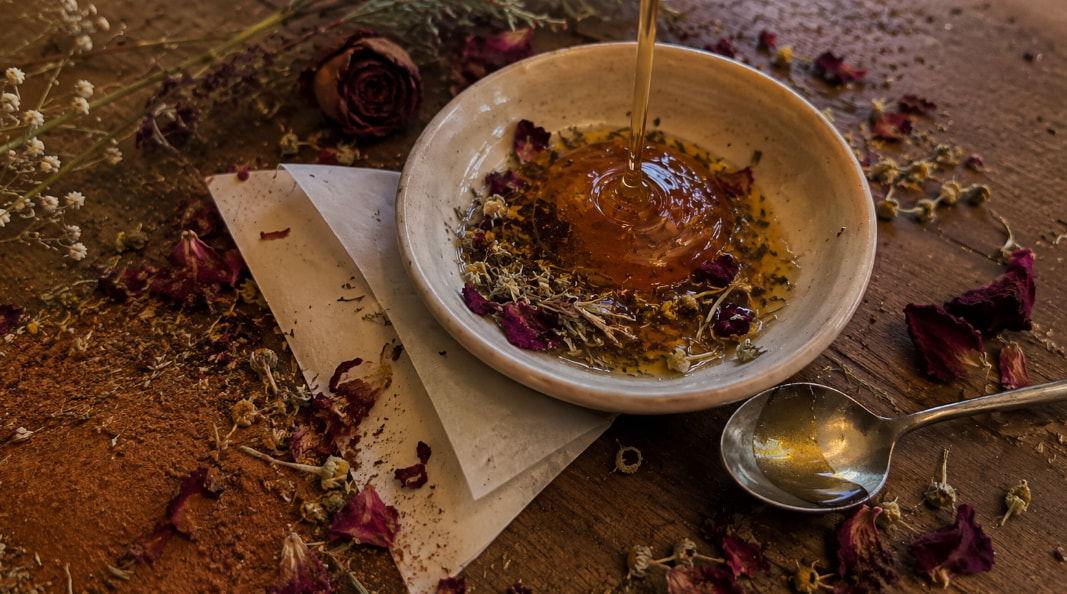
Honey slips into almost any working: drizzle it over a candle to fix herbs and intentions, stir it into tea with a whispered affirmation, add it to a bath, bake it into offering cakes, or seal it in a jar for the long game.
The one rule I hold to is patience, because honey is slow magic and it rewards repeated, gentle attention over a single dramatic gesture.
You can use honey in any kind of ritual that fits its correspondences, but if you want an example from my own Book of Shadows:
A Honey Jar to Sweeten and Persuade 
- Write the name of the person or situation three times on a slip of paper. Turn it a quarter-turn and write your own name three times across theirs.
- Around both names, write your petition in one unbroken line, then fold the paper toward you.
- Place it in a small clean jar with a pinch of cinnamon for warmth or rose for affection.
- Pour honey slowly over everything, and taste a little from the spoon before you seal it.
- Set a small candle
 on the lid and light it as you speak the chant.
 - Let it burn out safely, then re-light a fresh candle each Friday until your wish ripens.
Sweet to the tongue and sweet to the ear,
soften the heart and draw it near.
As honey keeps and honey stays,
let all grow sweeter through my days.
Then put the jar somewhere dark and let it work. The letting go is half the spell.
Blessed be 