Magical Properties of Salt (for Witches)

Long before I owned a single crystal or a fancy resin incense, I had a bag of coarse sea salt and a saltcellar by the door. Honestly, those two carried more of my early practice than anything else.

Salt is the witch’s workhorse. It’s cheap, it’s everywhere, and it does the quiet, unglamorous jobs that make every other magicak practice possible.
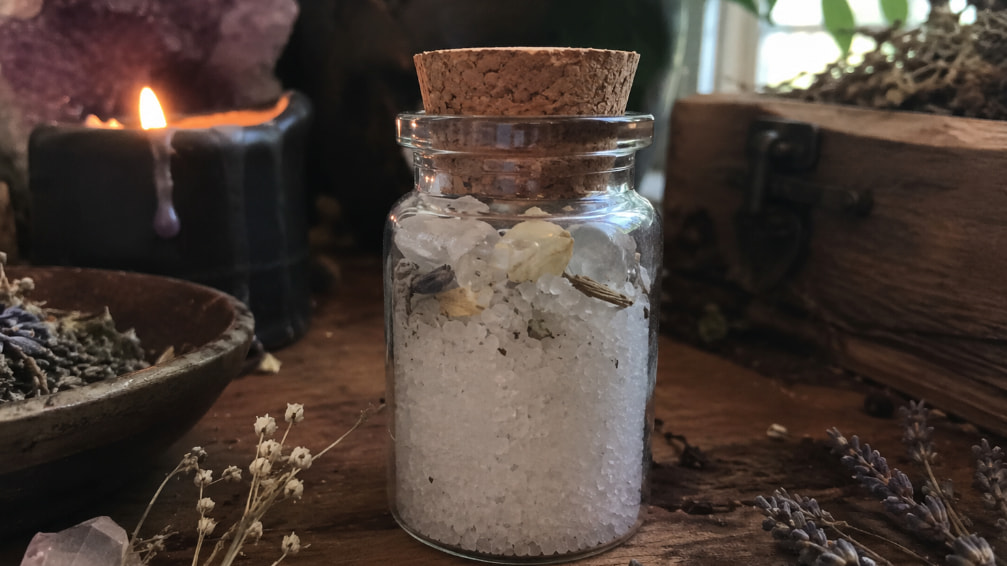
Salt is one of the first things baby witches usually work with. “Back in my day” (Goddess, that makes me sound old), they watched shows like Charmed, which showed protection circles being drawn with salt, and that’s still to this day a great first protection practice.

What draws me to salt is that its magic is rooted in what salt actually is.

It preserves. It dries things out. It absorbs. That mundane truth is the whole metaphysical fingerprint. Salt soaks up what shouldn’t linger and locks in what should. Salt is one of the few tools that grows with you instead of out of you. Please note this list is focused on plain white salt, but I have also covered the properties of black salt here. Please don’t go mixing those up.

Metaphysical Properties of Salt

In my experience, salt’s energy is feminine, receptive, and deeply grounding. It pulls things down and out. It clears instead of adding. Here’s how I’d break it down:

  • Purification: clearing stagnant, stuck, or heavy energy from spaces, tools, and people
  • Protection and warding: forming an energetic boundary against unwanted spirits and influence
  • Grounding: anchoring scattered energy and bringing you back into your body after heavy work
  • Banishing: evicting hostile or stale energies, especially when blended into black salt
  • Consecration: blessing and dedicating altars, tools, and sacred space
  • Absorption: acting as a spiritual sponge for psychic debris

One thing I’ll always flag for baby witches: salt doesn’t distinguish between “good” and “bad” energy. Leave an open bowl next to a charged working and it’ll quietly drain it. Dispose of used salt promptly and keep ritual salt sealed.

Magical Correspondences of Salt

Correspondence Attribution
Latin Name Sal / Salis
Planet Saturn (boundaries, banishing, protection)
Element Earth (rock salt); Water (sea salt)
Signs Capricorn, Taurus, Virgo; Cancer & Pisces for sea salt
Deities Aphrodite, Poseidon, Salacia, Njörðr, Lir, Huixtocihuatl, Hecate
Chakras Root (Muladhara); Sacral for sea salt
Day Saturday
Folk Names Witch’s Salt, the salt of the earth, white gold, rock salt
Sabbats Imbolc, Samhain, Yule, Ostara

Magickal Properties of Salt

The Great Purifier

For me, purification is where salt truly earns its keep.

Whenever I move into a new space, finish a difficult divination session, or simply feel that the air in a room has gone thick and stale, salt is the first thing I reach for. A pinch dissolved in water becomes a spray. A handful in the bath becomes a reset. It strips away the residue we accumulate without noticing, like other people’s moods, our own anxious loops, or the lingering weight of a hard day.

What I love is how honest the cleansing feels. Salt doesn’t mask or perfume the energy of a space the way incense can. It genuinely lifts and absorbs it. After a salt cleanse, a room feels lighter in a way I can only describe as quiet. I think this is why so many of us instinctively reach for it during Imbolc and the spring sabbats. That season is all about clearing out the old to make room for the green and the new.

I know some witches who will use salt to cleanse a space or an altar in between each ritual. Personally, I think it depends on the different types of work you are doing there, but it’s never a bad idea.

The Steadfast Guardian

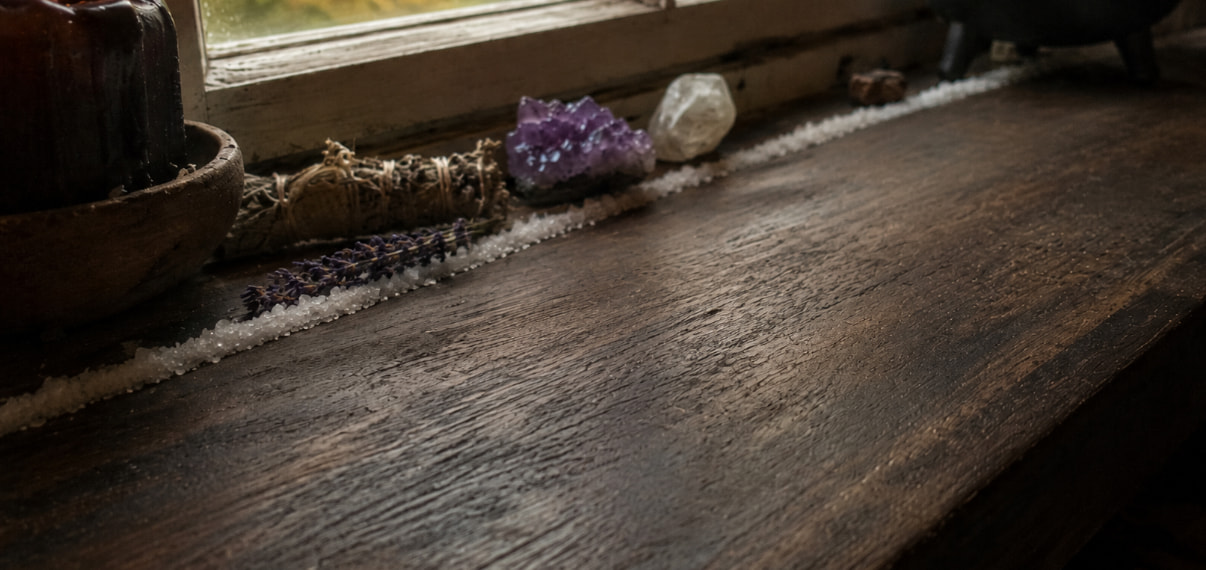
Salt’s protective reputation is ancient and, in my practice, utterly reliable. A thin line across a threshold, a pinch on each windowsill, or a circle poured around a working. These are the small, steady acts of warding that hold a home together. I renew my door lines weekly, and after any night that felt energetically rough, I do them again without hesitation.
Black salt is where this protection sharpens into something… fierce.

Blended with ash, charcoal, and black pepper, it becomes a banishing tool with teeth for breaking the hold of a hostile situation or sealing a boundary that keeps getting crossed. I treat black salt with respect and save it for the moments when you genuinely need something gone.

The Anchor

The third quality I lean on constantly is grounding.

Salt is pure Earth energy, and when my head is spinning with too much psychic input, holding a small bowl of it and breathing slowly pulls me straight back down into my body. It’s the antidote to that floaty, scattered feeling that comes after intense ritual or a long stretch of overthinking.

This is why I associate salt so strongly with the root chakra and with stability itself. A salt bath at the end of a draining week does double duty. It cleanses and it anchors, washing off what I’ve picked up while settling me firmly back into myself.

For grounding work, I like unprocessed rock or Himalayan salt that holds steady, mineral weight best.

l
Using Salt in Spellwork & Rituals

In general, salt slots into almost any practice.

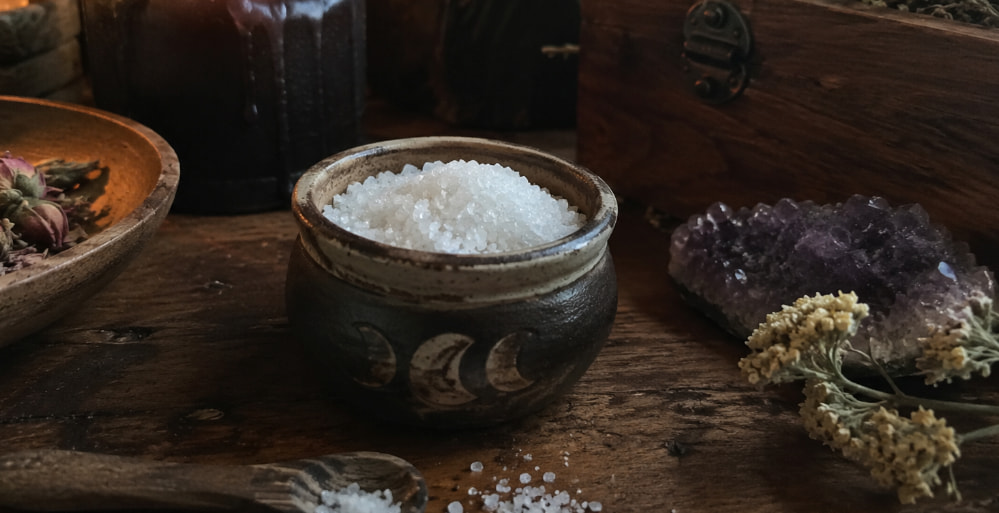
Cast a protective circle clockwise from the north, line your thresholds, layer it into a spell jar to absorb negativity, dissolve it into a cleansing bath, or add it to a floor wash to sweep stagnant energy out the front door. The rule I live by is to match the salt to the work. Sea salt for emotional release, rock or Himalayan for grounding and protection, black salt for banishing. And always dispose of “full” salt rather than reusing it.

Here’s a simple purification bath. Ideally on a full moon. :sparkles:

You will need: a white candle, two cups of sea salt, a handful of dried rosemary or lavender.

  1. Cleanse the bathroom, then light your white candle.
  2. Run a warm bath and add the salt and herbs.
  3. Stir the water clockwise with your hand as you speak the chant below.
  4. Soak for at least twenty minutes, visualising grey, smoky energy leaving through your fingertips and toes.
  5. As the water drains, consciously release everything it carried away, then rinse clean.

"By salt and water, deep and bright,
I shed the weight I bore tonight.
What drains away will not return.
I rise renewed, the old to burn."

Blessed be :heart:

14 Likes

Really solid write-up. The point about salt not distinguishing between good and bad energy is one I wish more people talked about. I’ve seen newer practitioners leave open bowls of salt right next to their charged spell jars and then wonder why their workings fizzle out. Salt just absorbs, no judgment.

One thing I want to add to the deity list. You mentioned Huixtocihuatl, which is great because she rarely gets brought up. She’s an Aztec fertility goddess who presided over salt and salt water, considered the older sister of the rain gods, including Tlaloc. The myth says she angered her younger brothers the Tlaloques by mocking them, so they banished her to the salt beds where she discovered how salt was made. During Tecuilhuitontli, there was a whole festival in her honor where salt-making women danced for ten days. She was also seen as a provider goddess alongside Chicomecoatl and Chalchiuhtlicue, the sisters who gave people salt as well as food and water. That dual life-giver and death-dealer thing fits salt’s properties pretty well.

Salt can damage soil and plants if you use too much outdoors. Learned that the hard way doing threshold work around a garden bed. Crushed eggshell makes a decent protective substitute that won’t kill everything around it.

1 Like

Matching salt to the work is one of those things that gets overlooked. Salt really is the backbone of the craft. Love this post. I wanted to add a bit on some less common salts worth knowing about.

Alaea red salt from Hawaii gets its colour from volcanic clay and iron oxide. Hawaiians traditionally used it to cleanse tools and homes, and that iron gives it a strong protective charge. Authentic stuff is getting harder to find though, since a lot sold now is made in California.

Celtic grey salt is another one I keep around. It’s a wet, unrefined sea salt from France with a greyish-purple tint from the minerals. Lower sodium than table salt and the extra minerals make it great for kitchen witchery.

Fleur de sel I only use for specific workings where I want that refined, precise energy. It’s collected from shallow pools in Brittany and it’s pricey because of the harvesting process, so it feels right to save it for delicate work.

On Himalayan pink salt, you mentioned the root chakra which is spot on for grounding, but the pink colour also links it to the heart chakra. It can help clear emotional attachments, especially after a rough breakup, so it does double duty depending on intent. I’ve found it useful in spells for removing blocks to love and friendship.

1 Like

Bookmarking this. One of the better reference posts I’ve seen. The thing I always come back to with salt is how deep the history runs. Ancient Egyptians used it in offerings, and so did the Greeks and Romans. The Greeks threw salt into fire during new moon rituals to make it crackle. Roman soldiers were paid in salt (salarium argentum), which is where we get the word salary. In Hinduism it shows up in house-warmings and weddings, and some people still use it to remove the evil eye by circling it around someone then throwing it away.

The old folklore around lending salt is interesting too. In parts of northern England and Scotland, it was considered bad luck because the borrower could use it to curse you. In the Ozarks there was a belief that witches avoided salt, so complaining that food was too salty could raise eyebrows.

All of this is why salt still feels so potent. When you pour a circle or line your door, you’re connecting to something that’s been used the same way for thousands of years. Also glad you mentioned disposing of used salt properly. It can kill plants if you dump it outside, so running water or the bin is better.

1 Like

In Shinto tradition, sumo wrestlers still throw salt before matches to cleanse the ring of negative energy. It’s a practice that goes back centuries and is still taken seriously, not just ceremonial.

Cultures across the world seem to have independently landed on salt as protective. Completely separate traditions, same conclusion.

Salt’s magical uses are endless. You’ll keep finding new ones as you grow in your practice. Different traditions approach it in different ways too, so what resonates on one path might look foreign on another. Same goes for other simple tools like nails or coins. They’re versatile because their magic adapts to the practitioner.

Keep experimenting, trust your intuition.

2 Likes

Some solid reading if you want to dig deeper into salt folklore. The Lucky Mojo page on salt magic is worth a look. It’s pretty thorough on the hoodoo perspective and good for understanding protective salt work.

Salt is a boundary tool for me. When I’m doing shadow work on things I need to release, like old attachments or generational patterns, I write it on paper, fold it up, and bury it in a bowl of salt overnight. It gives that energy somewhere to sit before I dispose of it the next morning. My therapist talks about externalizing emotions so you can observe them without getting swallowed by them. Salt does that energetically. It holds the thing outside you so you can process it and choose to let it go.

I’ve started thinking of salt as a way of honoring my own limits, not just protection from outside stuff. Setting that line is me saying “this is where I end.” Protection magic and self-protection feel like the same conversation.

2 Likes

Just keep it away from any antique pieces you have and might use in rituals. Salt is hell in iron and ruined my favorite pentacle.

Salt cleanses deeply. Like, deeply.

So if you’re feeling raw or grief-heavy right now, please be gentle with yourself. A smaller pinch ritual works just as well as a full purge, and sometimes better.

Salt just works. It pulls scattered energy right back down into your body. I was one of those baby witches drawing circles with salt but I would use bags of it. You only need a thin white line.

During the actual working, I skip salt entirely and go with smoke instead. Salt can have that energy-draining effect on whatever you’re trying to raise, but smoke clears mundane vibes and builds the space at the same time.

Black salt is specifically for the dead and void-dwellers. Regular salt does that spiritual bubble thing too. It absorbs stray energies and shields your workings from interference. Just a clean barrier that handles more than people give it credit for, especially magical interference. Though I’m sure you already knew all that given your clearly extensive saltcellar experience!

Remember that we call them salt crystals for a reason. We get so hung up on buying big expensive gem stones but a little bit of salt can go a very long way. I’ve layered it into money jars because of that absorptive quality. It draws and holds intention just as well as it banishes, maybe even better in some cases.

Never on living soil. Salt binds and withers everything in the ground, and once it’s there you’re dealing with damage that takes a long time to undo. Use eggshell powder or cornmeal at your outdoor thresholds instead. Salt is fine on stone surfaces and doorways.

Does anyone work with salt as an offering to land spirits or local entities? I’m talking about actually giving it, not just using it as a cleanser or barrier.

I’ve been leaving small pinches of coarse sea salt at the base of an old oak near my home. Just as a gesture of respect, almost like paying energetic rent for working in that space. The whole feel of my outdoor practice changed. It went from feeling tolerated to genuinely welcomed, which I wasn’t expecting that quickly. If you have a spot in nature where you do regular workings, even casual ones, just try it. Small offering, clear intention, see what happens. Using salt to give rather than just to take away builds a different kind of relationship with a place. Not always overnight, but often faster than you’d think.

6 Likes