While other Midsummer herbs whisper their magic, St. John’s Wort just shouts defiantly about it. Bright yellow, sun-rayed flowers blazing in late June, leaves perforated with tiny translucent windows that hold the light, and a sap that bleeds ruby red when you crush it between your fingers. The plant is solar magic made visible.
You don’t have to know a single correspondence to feel what it’s doing, but I thought it was high time we had a guide on how to work with it.
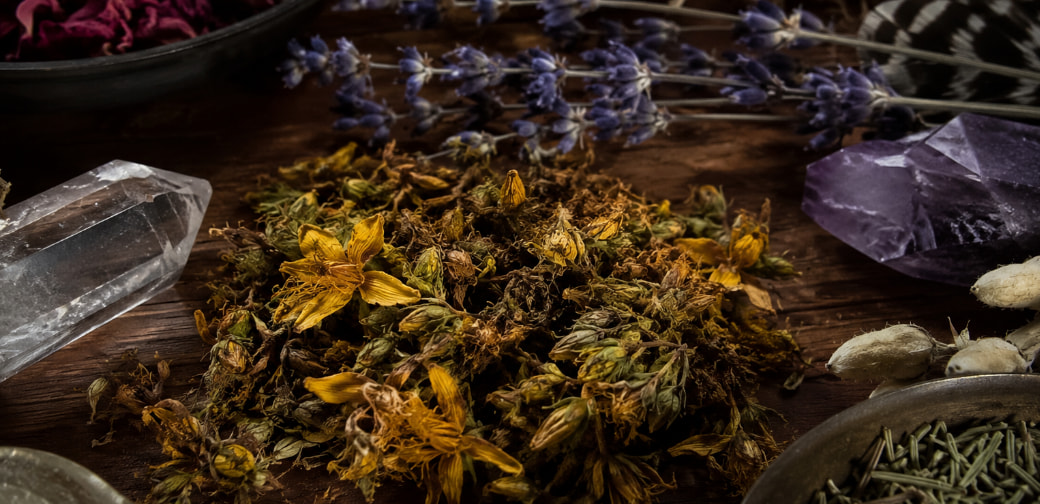
I keep a jar of dried St. John’s Wort on my kitchen windowsill and another bundle hung above the back door.
Once you start working with this herb, it earns a permanent place in your practice. It feels like a familiar friend and that’s maybe why it’s one of the oldest protective herbs in European folk magic.
Basic Properties of St. John’s Wort
St. John’s Wort is an herb of light pushing back against darkness.
It carries the energy of the noonday sun at its zenith. Where there is fear, it offers courage. Where there is grief, it offers a slow-warming joy. Where there is invasion, it builds a wall of fire.
Working with this plant feels like standing in a sunbeam.
- Protection against negative entities, hostile magic, the evil eye, and psychic attack
- Banishing of ghosts, poltergeists, and unwanted spiritual influences
- Exorcism of stagnant, oppressive, or possessing energies
- Healing of the emotional body, especially depression and melancholy along with grief
- Courage and personal power, anchored at the solar plexus
- Joy and radiance, calling the inner sun back online
- Prophetic dreaming, particularly around love and life-path questions
- Divination and the detection of hidden witchcraft worked against you
- Solar alignment, attuning the practitioner to the rhythms of the sun and the wheel of the year
Magical Correspondences of St. John’s Wort
| Correspondence | Attribution |
|---|---|
| Latin Name | Hypericum perforatum |
| Planet | Sun |
| Element | Fire |
| Zodiac Signs | Leo (primary), Libra (secondary) |
| Deities | Baldur, Apollo, Helios, Brigid, Lugh, Belenus |
| Chakras | Solar Plexus (primary), Root (secondary) |
| Day | Sunday |
| Folk Names | Chase-Devil, Devil’s Flight, Fuga Daemonum, Goat Weed, Klamath Weed, Tipton Weed, Amber, Sol Terrestris, Herb John, Witches’ Herb, Touch-and-Heal, Rosin Rose, God’s Wonder Plant |
| Sabbat | Litha (Midsummer) |
St. John’s Wort Magickal Properties
Now, the stuff you’ve really been waiting for.
Protection and Banishing
This is where St. John’s Wort earns its reputation, and where it earned every one of its folk names. It’s probably what brought you to this post.
Fuga Daemonum. Devil Chaser. Chase-Devil. There’s a reason medieval Europe hung this plant over every doorway and window in the house come Midsummer. It does not negotiate with intrusive energies. It evicts them.
If you’ve ever lived in a space that felt heavy or sticky like something was watching you, a smoke cleansing with dried St. John’s Wort tossed onto charcoal will shift the air within minutes. I’ve felt it move through a room like a draft.
For active warding, I lean on the classic English protective charm: trefoil, vervain, St. John’s Wort, and dill, bundled into a red flannel pouch and worn or hung. The plant is especially renowned for working against poltergeist activity, hostile witchcraft, and what older sources called fairy-leading, that disorienting sense of being walked off your path by something unseen.
Hang sprigs in your windows, dress your protection candles with the crushed dried herb, and let the sun do what the sun does.
Healing the Emotional Body
If protection is the herb’s loud song, emotional healing is its quiet one. St. John’s Wort works on the solar plexus, the seat of personal power and gut-instinct knowing, and it brings light back to places where the light has gone out. I think of it as the herb you give yourself when winter has lasted too long.
Whether that’s an actual winter or the kind that lives inside you.
Place a sprig over your heart during meditation. Anoint your solar plexus with infused oil before a difficult day. Drop a pinch into a yellow candle for joy work, or carry a sachet when you know you’re walking into something that’s going to test your nerve. The plant doesn’t override grief or pretend pain isn’t real. In my experience, it just refuses to let darkness be the only thing in the room. It holds space and turns up the dimmer switch slowly.
Divination and Prophetic Dreams
There’s a beautiful old tradition of placing St. John’s Wort under the pillow on Midsummer Eve to dream of your future spouse. I can’t promise your beloved will show up the next morning, but I can tell you the plant  opens the dreaming gates.
Pair it with lavender and mugwort (I’ve covered that one here, and it pairs well with St. John’s; you might want to stock up on both) in a dream pillow, set your intention before sleep, and pay attention to what comes through. The dreams tend to be vivid and golden-toned and often surprisingly direct.
Beyond romantic divination, the herb has a long folk history of revealing hidden magic worked against you. It indicates who in your life carries genuine intent versus performance and offers omens about the year ahead.
How to Use St. John’s Wort in Spellwork and Rituals
St. John’s Wort is one of the most versatile herbs in the witch’s cabinet, so there are a lot of different ways you can use it in your own practice. When I write these sections for a herb, they are always supposed to be guidelines and not hard-set rules.
This is especially true in this case. These are some ideas, but let your own intuition guide you here. You know what it works well with, how you combine and work with it is up to you.
Maybe hang it over doors and windows for warding. Bundle it into protection sachets. Burn it as banishing incense on charcoal, alone or paired with frankincense and dragon’s blood. Tuck it into dream pillows. Infuse fresh flowering tops in olive oil and leave the jar in direct sun for three to six weeks until the oil runs blood-red.
That’s St. John’s Blood, the most powerful anointing oil this herb produces, and a single jar will last you years of candle dressing, consecrations and ritual anointing. The plant accepts almost any working format you can throw at it, and rewards harvesting at the solstice with noticeably stronger potency for the year ahead.
A Solar Protection Ritual for the Home 
Best performed at noon on a sunny day, ideally a Sunday or Midsummer.
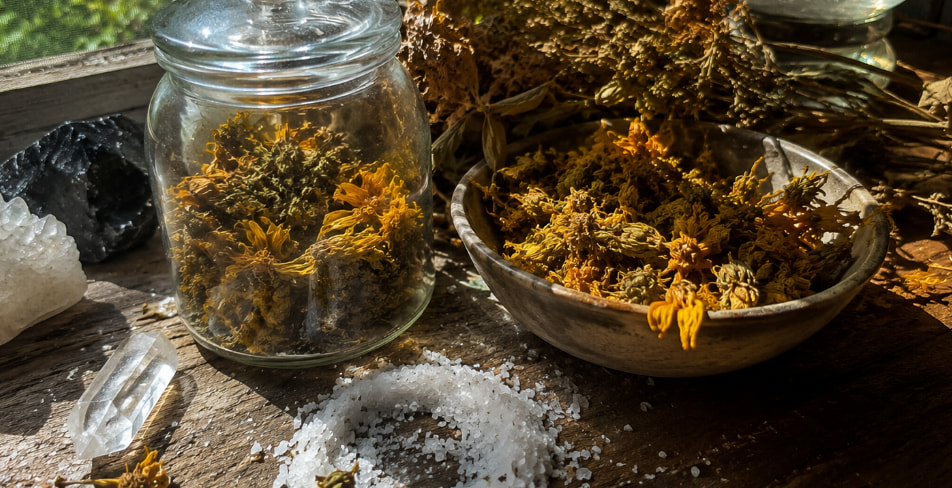
You will need: a yellow or gold candle, a small bowl of dried St. John’s Wort, a pinch of salt, a clear glass jar with a lid, and a window that catches direct sunlight.
The process:
- Open the window and let sunlight fall across your working surface. Place the candle in the light and anoint it from base to wick with a drop of olive oil (or St. John’s Wort oil if you have it).
- Sprinkle the salt in a small circle around the candle’s base, then layer the dried herb over the salt.
- Light the candle and hold the empty jar up to the sunlight. Let the light fill it. Feel it warming the glass.
- Speaking aloud, scoop the herb and salt mixture into the jar, repeating the chant below three times as you fill it.
- Seal the jar tightly and place it on your sunniest windowsill. Let the candle burn down completely in a safe vessel.
The chant:
Sun-bright herb of fire and gold,
Guard this house from young and old.
What is dark shall find no door,
What is bright shall be restored.
By the noonday and the flame,
I seal this work in my own name.
Refresh the jar each Midsummer by burying the old contents at the base of a tree and remaking it with freshly dried herb. The protection compounds year over year, and the windowsill becomes a small permanent anchor for solar warding in your home.
Blessed be 