Long before I understood correspondences or could name a single planetary ruler, I knew the smell of cedar made a room feel clean in a way that had nothing to do with dust. It is the scent of a space that has been sealed, settled, and set right.
Over the years cedar has become my workhorse for the unglamorous but essential business of protection and consecration, along with cleansing.
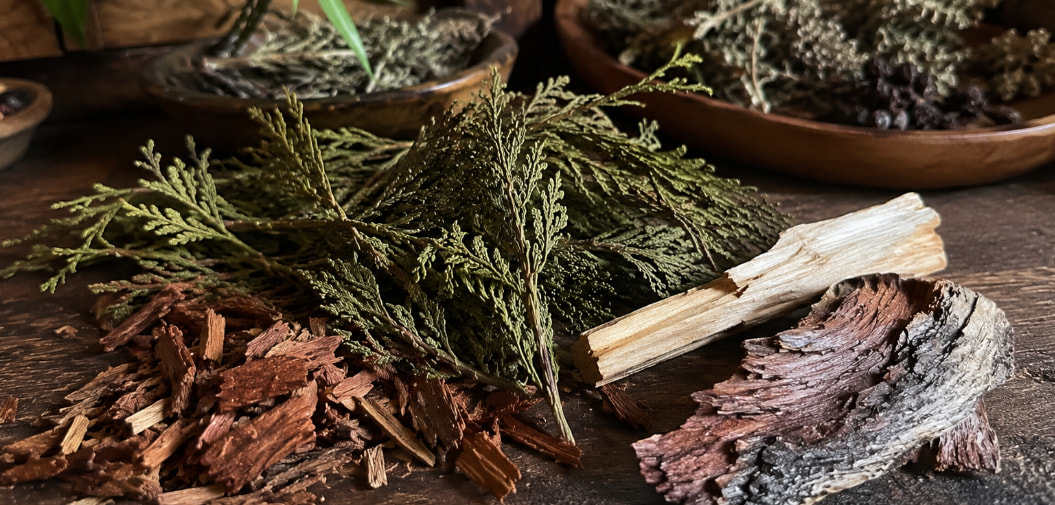
I want to talk about cedar specifically, because it gets lumped in with every other “abundance and sweet dreams” herb (or wood) and that does it a real disservice. Cedar is a guardian, old, rooted, rot-resistant, and a little severe rather than a soft, dreamy ally.
It keeps the dead company, seals thresholds, and makes a thing sacred. This is how I understand and work with it.
Metaphysical Properties of Cedar
Cedar’s energy is upright and unhurried. When I sit with it, endurance and boundary come to mind, along with witness. This is a tree whose endurance is almost beyond reckoning. Specimens of Cedrus libani in Lebanon’s Shouf Cedar Nature Reserve and the Cedars of God at Bsharri are estimated at over 3,000 years old.
That history lives inside its smoke and oil. Cedar takes up so much steady, ancient space that nothing unwanted can find room to stay, instead of chasing energy out of a room in a panic like some sharper herbs do. Pairs very well with Palo Santo for this exact reason.
- Protection and warding: a guardian wood traditionally hung at doors and windows and placed at the four corners of a space.
- Purification through smoke: one of the oldest cleansing incenses in the world, used to clear stagnant and heavy energy rather than merely freshen it.
- Consecration and sanctification: cedar clears a space and then consecrates it. It sanctifies. This is a wood for blessing tools, altars, and spaces.
- Strength, longevity, and resilience: the energy of something that endures storms and centuries. It is excellent for grounding the anxious and steadying the shaken.
- Banishing and release: it drives off what is unwelcome, including the energetic residue of grief and conflict, as well as old patterns.
- Ancestral and funerary work: long tied to the honored dead and safe passage. It is a faithful companion for veil-work.
- Guarding sleep: as the Encyclopedia of Magical Herbs puts it “The smoke of the cedar is purifying, and also cures the predisposition of having bad dreams.”
Magical Correspondences of Cedar
| Correspondence | Association |
|---|---|
| Latin name | Cedrus libani |
| Planet | Sun, though some traditions add Jupiter for abundance and Saturn for boundaries and longevity |
| Element | Fire (Earth when worked as wood for grounding) |
| Signs | Leo and Sagittarius |
| Deities | Ishtar, Enlil and Shamash (Mesopotamian); Osiris (Egyptian); plus solar and hearth figures such as Ra, Helios, and Hestia |
| Chakras | Root (grounding) and Solar Plexus (will and confidence) |
| Day | Sunday (solar work); Thursday for protection, Saturday for banishing |
| Folk Names | Tree of Life, Arborvitae, White Cedar, Grandmother Cedar, Evergreen Life |
| Sabbats | Yule and Samhain |
Magickal Properties of Cedar
Protection and the Sealed Threshold
If you take only one thing from cedar, let it be this: it is a threshold guardian. A shield above your door. The protector of your space.
The traditional folk practices are remarkably consistent across cultures. You see cedar hung above the door, branches laid at windows, and pieces placed at the four corners and along the boundary of a property while you ask for protection.
One classic charm is “a cedar stick carved into three prongs is placed prongs up into the ground near the home to protect it against all evil.” I grind dried cedar fine and walk the perimeter of my home with it a few times a year, and I keep a small carved piece by the front door.
What I love about cedar’s protection (well, one of the things) is that it is steady rather than aggressive.
Some protective herbs can feel like a slammed door. Cedar feels like a wall that was always there. It is excellent in spell jars, where a few tips will reinforce and seal the working against outside interference, and in charm bags carried for personal warding. When you want a shield that holds for the long haul, cedar is the wood.
It offers a permanent, rooted boundary rather than just a flash of repulsion.
Purification & Consecration With Sacred Smoke
Cedar is one of humanity’s oldest cleansing incenses, burned for centuries to purify both sacred and living spaces.
But I want to draw a careful distinction, because this is where cedar is specific. It clears a space and then consecrates it. It sanctifies.
This is why it has always been used for temple doors and altars. When I cleanse a new tool, crystal, or working space, cedar smoke is what I reach for, because it leaves behind a prepared, dedicated space ready for sacred work rather than a neutral blank.
A note on respect and sourcing, because cedar demands it.
People should never overharvest and should avoid taking pieces larger than the size of their hand.” I source my cedar ethically, and never claim ceremonies that are not mine. Folklore the world over warns against harming a cedar without proper reverence.
In the Epic of Gilgamesh, one of the earliest works of literature, the felling of the Cedar Forest’s trees is treated as a transgression against the gods.
Strength, Longevity & Faithful Dead
Cedar’s third great gift flows directly from its nature. It lives for many centuries and its wood will not rot. That endurance translates straight into magick.
Because cedar grows into a massive and enduring tree, it is used to instill inner strength, resilience, and stability. I carry a piece or wear the oil when I need to feel rooted and unshakeable in a storm, and it is one of my staples for grounding scattered, anxious energy. It is a confidence-builder and a spine-stiffener, the wood for when you need to stand like a tree.
That same incorruptibility is why cedar has always kept company with the dead.
At Yule, the other sabbat where I use it most. Cedar’s evergreen endurance speaks to life persisting through the darkest, deadest part of the year. It bridges worlds and preserves, protects passage, and… endures.
For ancestor work and veil-crossing, I would trust few allies more.
Cedar Spells & Rituals
Cedar is so wonderfully versatile in your witchcraft practice.
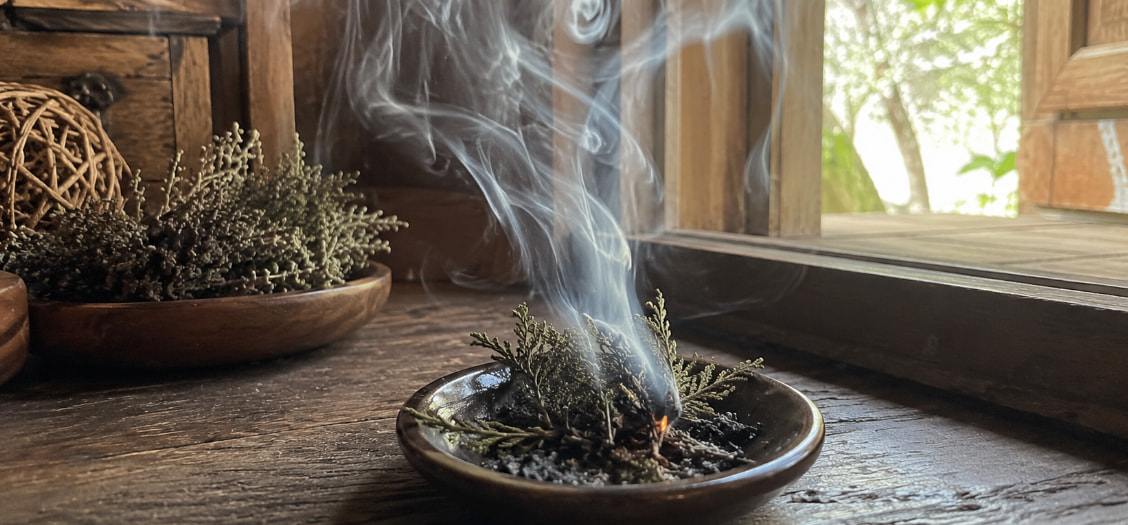
- The twigs and leaves can be burned as loose incense on charcoal or crumbled into incense blends.
- The wood and needles can be infused into oil.
- Dried leaves grind into protective powders to sprinkle in corners and across thresholds.
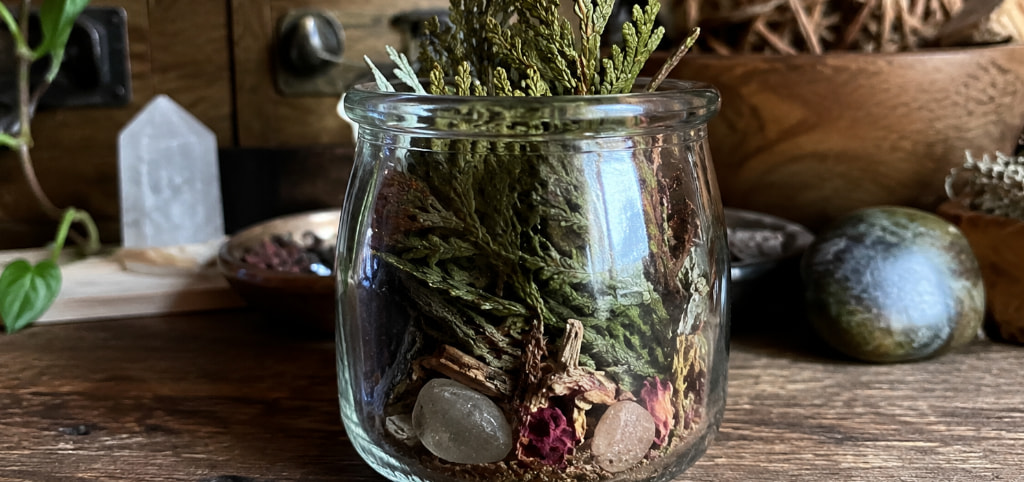
- Keep cedar tips in spell jars for sealing and protection.
- Tuck a sachet under your pillow to guard sleep.
- Add a handful to a cleansing bath, or simply hang a bundle over the door for steady, round-the-clock warding.
And I’ve included a short, simple ritual with Cedar from my own Book of Shadows. Tweak it to your liking as it serves your purpose - this is just an example.
Ritual: Sealing the Threshold
You will need a small bundle or pinch of dried cedar, a heatproof dish or charcoal, and a single  candle. The candle can be white for purification or black for banishing.
- Open a window. Light the candle and set your intention to cleanse and seal the space and to bless it.
- Light the cedar and let it smolder. Beginning at your front door, move clockwise through the space, letting the smoke gather in corners, doorways, and windows, the places energy stalls and slips in.
- As you go, picture the smoke knitting into a steady wall of warm, resinous light around the whole space, rooted deep like cedar roots.
- Return to the door. Waft a little smoke over yourself from head to foot to seal your own boundary.
- Pause at the threshold and speak the chant three times.
- Let the candle burn down safely, and bury or scatter the ashes outside at your boundary line.
Speak the chant with intention:
Cedar standing old and tall,
Build for me this guarding wall.
Smoke that cleanses, wood that wards,
Seal this threshold, bar the doors.
What is unwelcome cannot stay,
Rooted, sacred, here I lay.
Work with cedar a few times and you will feel what I mean about its character. It is not flashy and it does not rush. It is the ally you want at your back when you need something that simply holds. Hang a bundle, burn a pinch, carry a sliver, and let the oldest guardian in the forest keep your threshold.
Blessed be