I personally think Palo Santo is one of those woods that is (woefully) underappreciated. When it becomes a norm to use something without mindfulness in the practice, we lose a lot of the magickal properties of the element.
We see people burn it on social media behind the general idea of “cleansing,” but you can do so much more with even a small piece.
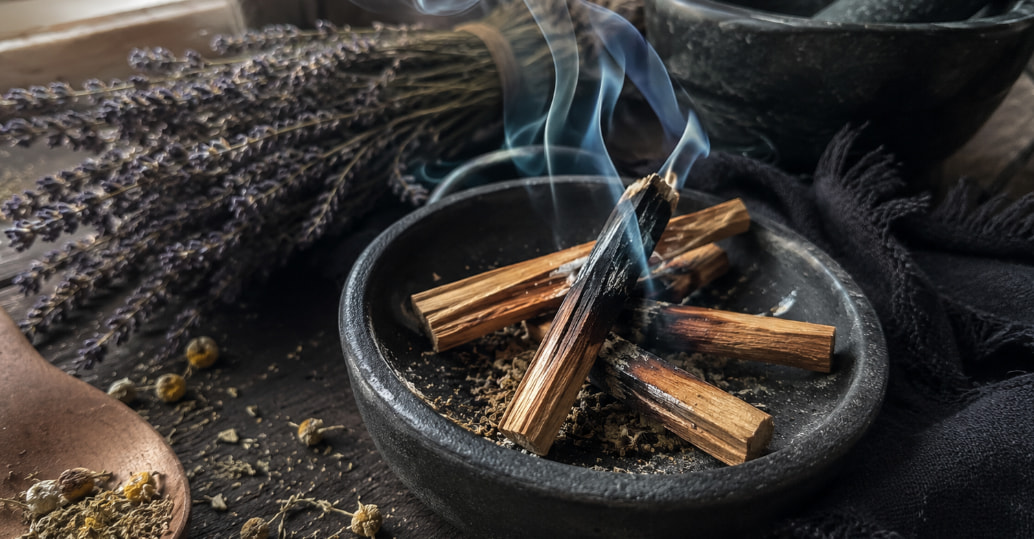
Its name means “holy wood” and it has been treated as sacred since at least the days of the Inca, whose curanderos burned it in purification rites to bless ceremonies and call in benevolent spirits.
I won’t wander far into history here. What matters for our craft is that palo santo arrives already carrying a reputation as a consecrator, a wood whose smoke sanctifies rather than merely scrubs. That is the spirit in which I work with it, and the spirit this guide is written in.
Metaphysical Properties for Palo Santo
On a felt, energetic level, palo santo is a wood of elevation.
Sage strips a space down to neutral, but Palo Santo does something subtler, selectively dissolving the dense, stagnant, low-frequency residue while actively raising the vibration of whatever remains. I think of sage as deep-cleaning and palo santo as… the redecorating afterward.
- Energetic clearing and purification: dispersing stale, stuck, or heavy energy from spaces, objects, and auras
- Raising vibration: lifting the overall frequency of a room toward calm, warmth, and welcome
- Grounding: anchoring you back into the body and the earth after intense or scattering work
- Protection: forming a soft shield against negativity, psychic residue, and ill intent
- Sacred-space consecration: marking the threshold between ordinary and ceremonial
- Creative ignition and clarity: sharpening focus and loosening the imagination
- Emotional release and peace: easing grief, anxiety, and the aftermath of conflict
What makes it distinctive, to my mind, is that it does these things warmly. You can find similar traits in other woods, but this is firm without being harsh.
The Magical Correspondences
| Correspondence | Association |
|---|---|
| Latin Name | Bursera graveolens |
| Planet | Sun (with a thread of Mercury) |
| Element | Fire, with a breath of Air |
| Signs | Leo, Sagittarius, Gemini |
| Deities | Pachamama, Sach’amama (Mother of the Forest), the espíritus buenos; echoes of St. Anthony in folk-Catholic practice |
| Chakras | Root, Solar Plexus, Crown |
| Day | Sunday |
| Folk Names | Holy Wood, Wood of the Saints, Sisaya (“flower opening”), St. Anthony’s Wood, Malka Waki |
| Sabbats | Litha, Mabon, Samhain |
A note for the table-purists: you’ll find practitioners who file palo santo under Air/Water and Mercury/Venus. I personally read it as solar Fire, that transformative, illuminating burn, but trust your own gnosis.
Magickal Properties
Clearing (But Not Banishing)
Where so many of us were taught to banish, to drive energy out by force, this little golden stick taught me a gentler grammar of magic.
It doesn’t scour a room bare, but it just lifts it. Part of its two-handed approach to energy. With one hand it sweeps away what’s stagnant. With the other it pours in light. This is why I never feel the need to fill a space afterward the way I do with harsher smoke. Palo santo leaves behind its own bright, resinous benediction.
That brightness isn’t only mystical, either. The aged heartwood is rich in limonene, the same compound that gives citrus its scent, so the wood literally clears the air as it clears the room.
I lean on this quality the most before any working that asks me to be open and vulnerable. Shadow work being an obvious example.
A few passes of smoke over my altar and over my own crown, and the static of the day falls away. The wood seems to discern, lifting the low without scrubbing out the love already present in a room. That selectivity is, for me, its truest magic.
Grounding (& the Quiet Shield)
For all its solar brightness, palo santo is a profoundly grounding wood, and I credit its root-chakra resonance for that.
When ritual or empathic overwhelm leaves me scattered and floating, its smoke pulls me back down into my body and into the earth beneath the floorboards. I’ll often carry an unburned piece in a pocket or charm bag on travel days for exactly this anchoring effect. It doesn’t need flame to work.
That grounding shades naturally into protection. Andean travelers carried it as a guardian on journeys, and I use it the same way, as a soft, golden barrier rather than a wall of thorns. Burned before divination or dream work, it steadies the channel and keeps misleading influences at bay, so that whatever insight comes through arrives clean.
Creative Fire and the Opening Flower
One of my favorite names for this wood is the Quechua Sisaya or “flower opening” because that is precisely what it does to a stuck mind.
When I’m blocked at the writing desk or before any act of making, I light a stick and let the citrus-pine smoke move through the room, and something in the imagination unclenches and blooms. The old reputation as a kindler of creativity and concentration is entirely earned.
This same opening quality makes it a beautiful bridge to spirit. Its smoke has long been understood to carry, lifting prayers and intentions upward while inviting grace down. When I consecrate a space for ceremony, palo santo is how I tell the unseen that this hour is set apart, sanctified, and ready.
Palo Santo Ritual & Spellwork
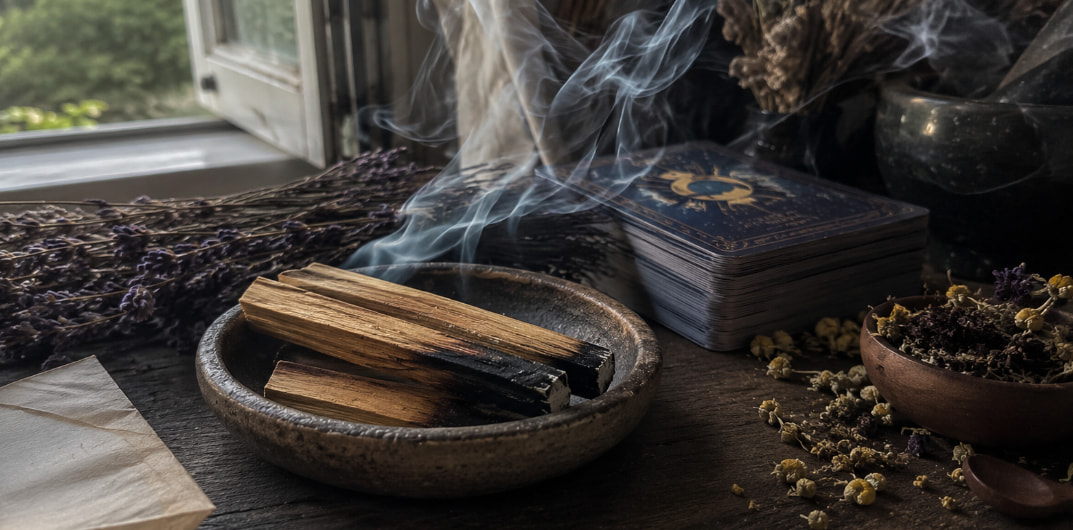
In practice, palo santo is wonderfully versatile. Light the tip, let it catch for thirty seconds or so, then blow out the flame and let the smoke do the work.
I waft it over altars, crystals, and tarot decks, tuck shavings into charm bags, add a few pieces to candle and bath workings, and pass written intentions through its smoke to charge them. Always keep a fireproof dish beneath it, crack a window so released energy has somewhere to go, and treat the spirit of the wood with genuine respect.
Never on the floor, never near the bin.
Here is a simple clearing-and-blessing rite I return to whenever a space needs a reset:
 A Rite of the Holy Wood
-
Open a window and still yourself. Light a single candle and set your intention plainly: to release the old and welcome the bright.
-
Light your palo santo from the candle, let it flame, then blow it gently to a smolder.
-
Move clockwise through the space, guiding the smoke into every corner, doorway, and threshold.
-
Pass the smoke over your own body, from crown to feet, then over any tools or crystals you wish to bless.
-
As you walk, speak the chant aloud:
Holy wood, your smoke runs clear,
Lift the heavy, draw the dear;
Sweep the shadowed, raise the light,
Bless this space and set it right.
- Return to your candle, give thanks to the wood’s spirit, and rest the stick in its dish to fade out on its own.
Practitioner to practitioner: please source your palo santo from naturally fallen wood and honest, ideally Indigenous-linked suppliers. The true ritual species is actually listed as “Least Concern” The endangerment scare comes from confusion with an unrelated timber tree. Yet the dry forests it calls home are gravely pressured, with only a sliver of that original woodland still standing.
Good practice everywhere now restricts harvest to wood that has fallen of its own accord. The spirit of this wood answers best to gratitude and reciprocity. Burn it like the holy thing it is.
Blessed be 